
The Next American Energy Revolution is Already Underway
Why Now Is the Moment to Launch the Enhanced Geothermal Systems Deployment Coalition
By Tim Latimer, CEO, Fervo Energy & Trey Lowe, CTO, Devon Energy
America is entering a new era of energy demand. Artificial intelligence (AI), advanced manufacturing, and broad electrification are driving rapid growth in electricity demand. At the same time, our legacy baseload generators are retiring faster than firm replacement capacity is being built.
The result is a growing reliability gap that is putting American prosperity and security at risk. Across U.S. power markets, electricity demand is projected to outpace planned generation additions so significantly that the country could face a 98-gigawatt baseload capacity shortfall by 2035, representative of roughly 10 percent of the country’s electricity generation capacity.
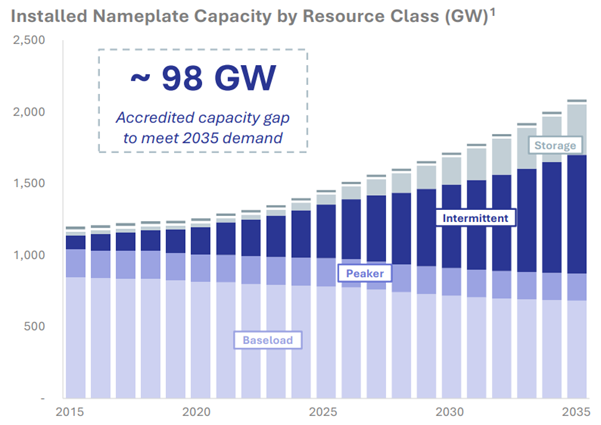
Source: Rystad Energy
Fortunately, we have a solution ready to go today. Enhanced Geothermal Systems (EGS) can deliver scalable, reliable, and affordable power now. The technology is proven. Deployment is underway. And a broad range of stakeholders, from oil and gas workers to domestic manufacturers to consumers, stand to benefit. The remaining barrier is not technology, workforce, or economics – it is policy.
That is why we have brought partners across diverse industries together to launch the Enhanced Geothermal Systems Deployment Coalition (EGS DC), an association dedicated to accelerating the deployment of next-generation geothermal power across the United States. Our goal is simple: deploy enhanced geothermal quickly and at scale, delivering the gigawatts of reliable, always-on power our grid—and our nation—urgently needs. This is about powering the AI revolution, strengthening our national security, and ensuring America’s continued role in global energy leadership and innovation.
Engineering Geothermal for Scale
For decades, geothermal energy has been constrained by geography. Traditional development required a rare alignment of specific subsurface conditions: natural heat and permeable rock. While these sites can be highly productive where they exist, their scarcity has kept geothermal on the periphery of our national energy strategy.
Enhanced geothermal fundamentally changes that model.
By applying proven technologies from the oil and gas industry — including horizontal drilling and multistage hydraulic fracturing — EGS developers engineer the subsurface to create the conditions necessary for commercial power generation. As a result, EGS is designed for scale and positioned to benefit from rapid cost reductions. By freeing geothermal from geological constraints, projects can grow from hundreds of megawatts to multi-gigawatt developments.
Fervo’s Cape Station development in Utah, which will deliver first power this year, is designed to scale to 500 megawatts with permits for up to 2 gigawatts. The resource beneath the project exceeds 4 gigawatts—roughly equivalent to the entire traditional geothermal industry operating in the United States today.
Recent Department of Energy (DOE) reports highlight the full opportunity: the United States could deploy at least 300 gigawatts of geothermal power by 2050, enough to transform geothermal from a niche resource into a foundational source of American energy.
Speed to Power
In the face of pressing reliability threats, speed matters. EGS can deliver new firm power in years, not decades.
Where permitting and interconnection are in place, EGS projects can be drilled, built, and brought online in less than 24 months, with timelines expected to fall to roughly 18 months. The technologies required to build these systems are already deployed at scale across the United States thanks to the nation’s world-leading oil and gas industry — the same industry that supplies the natural gas powering much of the grid today. Few new energy resources can move from beginning of construction to electricity production this quickly.
As an example, since 2022, Fervo’s drilling time has decreased by approximately 75 percent and per-foot drilling costs by roughly 70 percent, improvements reminiscent of the early shale revolution. Repetition, data integration, and standardization are driving rapid cost and efficiency gains. If policy reform can follow the pace of innovation, EGS can deploy rapidly to provide the firm power needed to support the AI-driven economy and strengthen American competitiveness.
Why We’re Launching the Enhanced Geothermal Systems Deployment Coalition
Despite technological innovation and industry momentum, geothermal remains under-supported relative to other energy technologies. With slow permitting timelines and limited commercialization support, the federal government has not yet harnessed geothermal’s full potential.
The Enhanced Geothermal Systems Deployment Coalition exists to close the gap between technological readiness and large-scale deployment. By uniting the entire EGS supply chain — including developers, oil and gas producers, manufacturers, utilities, hyperscalers, and investors — the Coalition will:
advocate for comprehensive geothermal permitting reform, including categorical exclusions for low-impact exploration and appraisal drilling and sufficient agency staffing;
support transmission and interconnection reforms, including robust interregional transmission planning and modern interconnection rules that prioritize fast-to-deploy resources like EGS;
champion significantly expanded federal funding for EGS deployment; and
defend long-term tax certainty for geothermal technologies.
Accelerating deployment will not only strengthen grid reliability but also expand the supply of clean electricity available to power the American economy. If the United States is to replace retiring baseload plants, avoid a projected 98-gigawatt capacity shortfall, power the AI economy, and maintain energy affordability, we must accelerate domestic geothermal buildout.
America’s Competitive Advantage
No country is better positioned than the United States to lead in enhanced geothermal deployment.
EGS builds on America’s existing oil and gas industrial base, including suppliers that manufacture drilling rigs, casing, drill bits, turbines, generators, and power electronics. America’s workforce, which includes engineers, geoscientists, and field operators, brings decades of subsurface expertise and can be deployed quickly. This is American equipment, American labor, and American innovation powering a domestic energy resource. Fervo’s Cape Station Phase 1 alone brought 250 temporary jobs and 30 permanent on-site jobs to rural Utah — direct evidence that EGS creates jobs where Americans need them.
At the same time, commercial demand is strong. Utilities and large corporate buyers are actively seeking firm, 24/7 power to meet reliability requirements and rising electricity demand. Like conventional geothermal, EGS produces electricity without combustion and with near-zero operational emissions. Long-term power purchase agreements with investment-grade buyers already demonstrate strong market demand for scalable, reliable power sources like EGS. For many of these buyers, particularly large technology companies and manufacturers, access to reliable carbon-free electricity is also a central requirement. Enhanced geothermal offers a pathway to meet reliability, affordability and emissions objectives simultaneously.
Enhanced geothermal is ready, and now is the moment to deploy it at the scale this country requires. By delivering reliable, always-on, clean power, EGS can strengthen the grid, reduce emissions, and help secure America’s long-term energy future. With coordinated policy support and continued industry leadership, the United States can unlock one of the largest sources of firm, domestic power available. The Enhanced Geothermal Systems Deployment Coalition was created to help make that future possible.